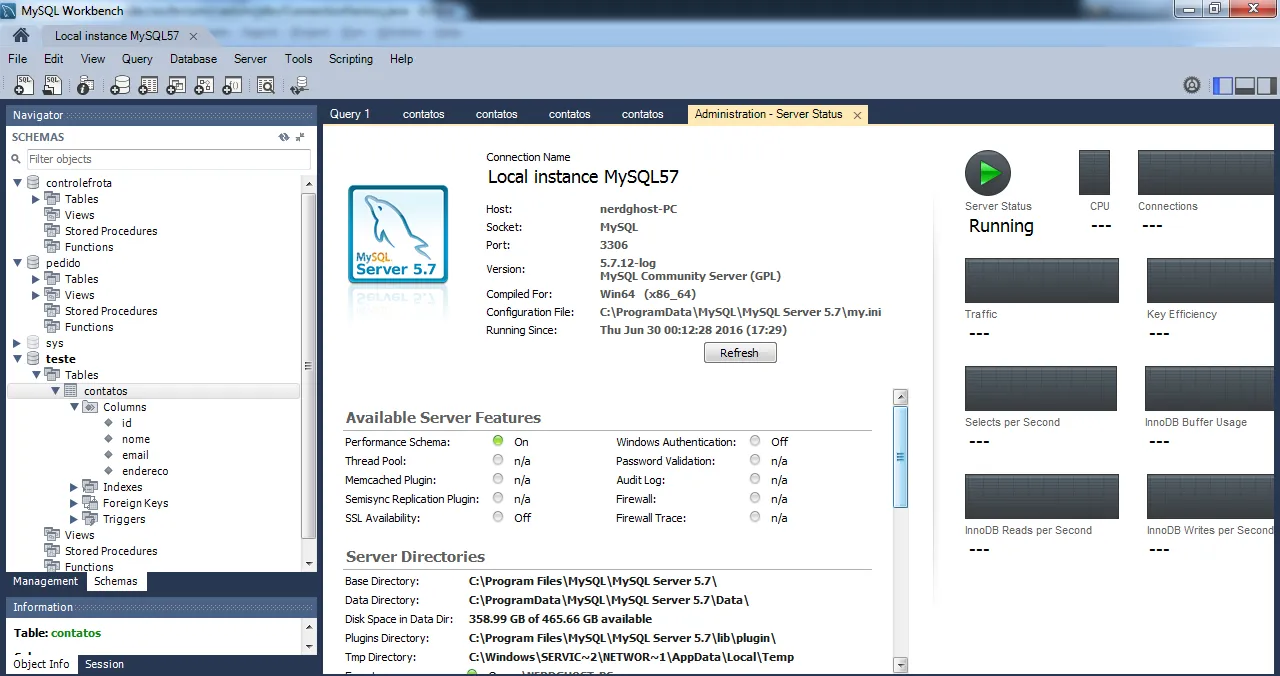
Pessoal estou começando a estudar Java e estou com dificuldades neste exercício, estou tentando inserir dados porém ele mostra esse erro:
package br.com.caelum.jdbc;

import java.sql.*;

public class JDBCInsere {

	public static void main(String[] args) {
		try {
			// conectando
			Connection con = ConnectionFactory.getConnection();
			// cria um preparedStatement
			PreparedStatement stmt = con.prepareStatement("insert into contatos (nome,email,endereco) values (?,?,?)");
			// preenche os valores
			stmt.setString(1, "Caelum");
			stmt.setString(2, "[email removido]");
			stmt.setString(3, "R. Vergueiro 3185 cj57");
			// executa
			stmt.execute();
			stmt.close();
		} catch (SQLException e) {
			e.printStackTrace();
		}
	}
}
The user to connect as The password to use when connecting The name of the class that the driver should use for creating socket connections to the server. This class must implement the interface 'com.mysql.jdbc.SocketFactory' and have public no-args constructor. Timeout for socket connect (in milliseconds), with 0 being no timeout. Only works on JDK-1.4 or newer. Defaults to '0'. Timeout on network socket operations (0, the default means no timeout). A comma-delimited list of classes that implement "com.mysql.jdbc.ConnectionLifecycleInterceptor" that should notified of connection lifecycle events (creation, destruction, commit, rollback, setCatalog and setAutoCommit) and potentially alter the execution of these commands. ConnectionLifecycleInterceptors are "stackable", more than one interceptor may be specified via the configuration property as a comma-delimited list, with the interceptors executed in order from left to right. Load the comma-delimited list of configuration properties before parsing the URL or applying user-specified properties. These configurations are explained in the 'Configurations' of the documentation. Comma-delimited list of classes that implement com.mysql.jdbc.AuthenticationPlugin and which will be used for authentication unless disabled by "disabledAuthenticationPlugins" property. Name of a class implementing com.mysql.jdbc.AuthenticationPlugin which will be used as the default authentication plugin (see below). It is an error to use a class which is not listed in "authenticationPlugins" nor it is one of the built-in plugins. It is an error to set as default a plugin which was disabled with "disabledAuthenticationPlugins" property. It is an error to set this value to null or the empty string (i.e. there must be at least a valid default authentication plugin specified for the connection, meeting all constraints listed above). Name or IP address of SOCKS host to connect through. Port of SOCKS server. Maximum allowed packet size to send to server. If not set, the value of system variable 'max_allowed_packet' will be used to initialize this upon connecting. This value will not take effect if set larger than the value of 'max_allowed_packet'. Also, due to an internal dependency with the property "blobSendChunkSize", this setting has a minimum value of "8203" if "useServerPrepStmts" is set to "true". If connecting using TCP/IP, should the driver set SO_KEEPALIVE? If connecting using TCP/IP, should the driver set SO_TCP_NODELAY (disabling the Nagle Algorithm)? If connecting using TCP/IP, should the driver set SO_RCV_BUF to the given value? The default value of '0', means use the platform default value for this property) If connecting using TCP/IP, should the driver set SO_SND_BUF to the given value? The default value of '0', means use the platform default value for this property) If connecting using TCP/IP, should the driver set traffic class or type-of-service fields ?See the documentation for java.net.Socket.setTrafficClass() for more information. Should the driver try to re-establish stale and/or dead connections? If enabled the driver will throw an exception for a queries issued on a stale or dead connection, which belong to the current transaction, but will attempt reconnect before the next query issued on the connection in a new transaction. The use of this feature is not recommended, because it has side effects related to session state and data consistency when applications don't handle SQLExceptions properly, and is only designed to be used when you are unable to configure your application to handle SQLExceptions resulting from dead and stale connections properly. Alternatively, as a last option, investigate setting the MySQL server variable "wait_timeout" to a high value, rather than the default of 8 hours. Use a reconnection strategy appropriate for connection pools (defaults to 'false') When failing over in autoReconnect mode, should the connection be set to 'read-only'? Maximum number of reconnects to attempt if autoReconnect is true, default is '3'. If autoReconnect is set to true, should the driver attempt reconnections at the end of every transaction? When using loadbalancing or failover, the number of times the driver should cycle through available hosts, attempting to connect. Between cycles, the driver will pause for 250ms if no servers are available. If autoReconnect is enabled, the initial time to wait between re-connect attempts (in seconds, defaults to '2'). When autoReconnect is enabled, and failoverReadonly is false, should we pick hosts to connect to on a round-robin basis? Number of queries to issue before falling back to the primary host when failed over (when using multi-host failover). Whichever condition is met first, 'queriesBeforeRetryMaster' or 'secondsBeforeRetryMaster' will cause an attempt to be made to reconnect to the primary host. Setting both properties to 0 disables the automatic fall back to the primary host at transaction boundaries. Defaults to 50. How long should the driver wait, when failed over, before attempting to reconnect to the primary host? Whichever condition is met first, 'queriesBeforeRetryMaster' or 'secondsBeforeRetryMaster' will cause an attempt to be made to reconnect to the master. Setting both properties to 0 disables the automatic fall back to the primary host at transaction boundaries. Time in seconds, defaults to 30 By default, a replication-aware connection will fail to connect when configured master hosts are all unavailable at initial connection. Setting this property to 'true' allows to establish the initial connection, by failing over to the slave servers, in read-only state. It won't prevent subsequent failures when switching back to the master hosts i.e. by setting the replication connection to read/write state. By default, a replication-aware connection will fail to connect when configured slave hosts are all unavailable at initial connection. Setting this property to 'true' allows to establish the initial connection. It won't prevent failures when switching to slaves i.e. by setting the replication connection to read-only state. The property 'readFromMasterWhenNoSlaves' should be used for this purpose. Replication-aware connections distribute load by using the master hosts when in read/write state and by using the slave hosts when in read-only state. If, when setting the connection to read-only state, none of the slave hosts are available, an SQLExeception is thrown back. Setting this property to 'true' allows to fail over to the master hosts, while setting the connection state to read-only, when no slave hosts are available at switch instant. Should the driver use the in-transaction state provided by the MySQL protocol to determine if a commit() or rollback() should actually be sent to the database? If prepared statement caching is enabled, how many prepared statements should be cached? If prepared statement caching is enabled, what's the largest SQL the driver will cache the parsing for? Name of a class implementing com.mysql.jdbc.CacheAdapterFactory, which will be used to create caches for the parsed representation of client-side prepared statements. Name of a class implementing com.mysql.jdbc.CacheAdapterFactory<String, Map<String, String>>, which will be used to create caches for MySQL server configuration values Should the driver always communicate with the database when Connection.setTransactionIsolation() is called? If set to false, the driver will only communicate with the database when the requested transaction isolation is different than the whichever is newer, the last value that was set via Connection.setTransactionIsolation(), or the value that was read from the server when the connection was established. Note that useLocalSessionState=true will force the same behavior as alwaysSendSetIsolation=false, regardless of how alwaysSendSetIsolation is set. Should the driver maintain various internal timers to enable idle time calculations as well as more verbose error messages when the connection to the server fails? Setting this property to false removes at least two calls to System.getCurrentTimeMillis() per query. The JDBC specification requires the driver to automatically track and close resources, however if your application doesn't do a good job of explicitly calling close() on statements or result sets, this can cause memory leakage. Setting this property to true relaxes this constraint, and can be more memory efficient for some applications. Also the automatic closing of the Statement and current ResultSet in Statement.closeOnCompletion() and Statement.getMoreResults ([Statement.CLOSE_CURRENT_RESULT | Statement.CLOSE_ALL_RESULTS]), respectively, ceases to happen. This property automatically sets holdResultsOpenOverStatementClose=true. Should the driver retrieve the default calendar when required, or cache it per connection/session? If using MySQL-4.1 or newer, should the driver only issue 'set autocommit=n' queries when the server's state doesn't match the requested state by Connection.setAutoCommit(boolean)? Sets the default escape processing behavior for Statement objects. The method Statement.setEscapeProcessing() can be used to specify the escape processing behavior for an individual Statement object. Default escape processing behavior in prepared statements must be defined with the property 'processEscapeCodesForPrepStmts'. When enabled, query timeouts set via Statement.setQueryTimeout() use a shared java.util.Timer instance for scheduling. Even if the timeout doesn't expire before the query is processed, there will be memory used by the TimerTask for the given timeout which won't be reclaimed until the time the timeout would have expired if it hadn't been cancelled by the driver. High-load environments might want to consider disabling this functionality. Should the driver close result sets on Statement.close() as required by the JDBC specification? What size result set row should the JDBC driver consider "large", and thus use a more memory-efficient way of representing the row internally? If using a load-balanced connection to connect to SQL nodes in a MySQL Cluster/NDB configuration (by using the URL prefix "jdbc:mysql:loadbalance://"), which load balancing algorithm should the driver use: (1) "random" - the driver will pick a random host for each request. This tends to work better than round-robin, as the randomness will somewhat account for spreading loads where requests vary in response time, while round-robin can sometimes lead to overloaded nodes if there are variations in response times across the workload. (2) "bestResponseTime" - the driver will route the request to the host that had the best response time for the previous transaction. If 'emulateLocators' is configured to 'true', what size buffer should be used when fetching BLOB data for getBinaryInputStream? Should the driver issue appropriate statements to implicitly set the transaction access mode on server side when Connection.setReadOnly() is called? Setting this property to 'true' enables InnoDB read-only potential optimizations but also requires an extra roundtrip to set the right transaction state. Even if this property is set to 'false', the driver will do its best effort to prevent the execution of database-state-changing queries. Requires minimum of MySQL 5.6. Should the driver use multiqueries (irregardless of the setting of "allowMultiQueries") as well as rewriting of prepared statements for INSERT into multi-value inserts when executeBatch() is called? Notice that this has the potential for SQL injection if using plain java.sql.Statements and your code doesn't sanitize input correctly. Notice that for prepared statements, server-side prepared statements can not currently take advantage of this rewrite option, and that if you don't specify stream lengths when using PreparedStatement.set*Stream(), the driver won't be able to determine the optimum number of parameters per batch and you might receive an error from the driver that the resultant packet is too large. Statement.getGeneratedKeys() for these rewritten statements only works when the entire batch includes INSERT statements. Please be aware using rewriteBatchedStatements=true with INSERT .. ON DUPLICATE KEY UPDATE that for rewritten statement server returns only one value as sum of all affected (or found) rows in batch and it isn't possible to map it correctly to initial statements; in this case driver returns 0 as a result of each batch statement if total count was 0, and the Statement.SUCCESS_NO_INFO as a result of each batch statement if total count was > 0. Use newer result set row unpacking code that skips a copy from network buffers to a MySQL packet instance and instead reads directly into the result set row data buffers. Should the driver use a per-connection cache of character set information queried from the server when necessary, or use a built-in static mapping that is more efficient, but isn't aware of custom character sets or character sets implemented after the release of the JDBC driver? Use internal String->Date/Time/Timestamp conversion routines to avoid excessive object creation? This is part of the legacy date-time code, thus the property has an effect only when "useLegacyDatetimeCode=true." Use internal String->Integer conversion routines to avoid excessive object creation? Always use the character encoding routines built into the JVM, rather than using lookup tables for single-byte character sets? Use newer, optimized non-blocking, buffered input stream when reading from the server? The name of a class that implements "com.mysql.jdbc.log.Log" that will be used to log messages to. (default is "com.mysql.jdbc.log.StandardLogger", which logs to STDERR) Should the driver gather performance metrics, and report them via the configured logger every 'reportMetricsIntervalMillis' milliseconds? Trace queries and their execution/fetch times to the configured logger (true/false) defaults to 'false' Deprecated, use 'profileSQL' instead. Trace queries and their execution/fetch times on STDERR (true/false) defaults to 'false' If 'gatherPerfMetrics' is enabled, how often should they be logged (in ms)? Controls the maximum length/size of a query that will get logged when profiling or tracing The maximum number of packets to retain when 'enablePacketDebug' is true If 'logSlowQueries' is enabled, how long should a query (in ms) before it is logged as 'slow'? If 'useNanosForElapsedTime' is set to true, and this property is set to a non-zero value, the driver will use this threshold (in nanosecond units) to determine if a query was slow. Should the driver issue 'usage' warnings advising proper and efficient usage of JDBC and MySQL Connector/J to the log (true/false, defaults to 'false')? Should the driver dump the SQL it is executing, including server-side prepared statements to STDERR? Instead of using slowQueryThreshold* to determine if a query is slow enough to be logged, maintain statistics that allow the driver to determine queries that are outside the 99th percentile? The name of a class that implements the com.mysql.jdbc.JDBC4ClientInfoProvider interface in order to support JDBC-4.0's Connection.get/setClientInfo() methods Should the driver dump the field-level metadata of a result set into the exception message when ResultSet.findColumn() fails? Should the driver dump the contents of the query sent to the server in the message for SQLExceptions? When enabled, a ring-buffer of 'packetDebugBufferSize' packets will be kept, and dumped when exceptions are thrown in key areas in the driver's code If 'logSlowQueries' is enabled, should the driver automatically issue an 'EXPLAIN' on the server and send the results to the configured log at a WARN level? Include the output of "SHOW ENGINE INNODB STATUS" in exception messages when deadlock exceptions are detected? Include a current Java thread dump in exception messages when deadlock exceptions are detected? Include the name of the current thread as a comment visible in "SHOW PROCESSLIST", or in Innodb deadlock dumps, useful in correlation with "includeInnodbStatusInDeadlockExceptions=true" and "includeThreadDumpInDeadlockExceptions=true". Should queries that take longer than 'slowQueryThresholdMillis' be logged? Should the driver log XA commands sent by MysqlXaConnection to the server, at the DEBUG level of logging? Name of a class that implements the interface com.mysql.jdbc.profiler.ProfilerEventHandler that will be used to handle profiling/tracing events. If the usage advisor is enabled, how many rows should a result set contain before the driver warns that it is suspiciously large? Should trace-level network protocol be logged? For profiling/debugging functionality that measures elapsed time, should the driver try to use nanoseconds resolution if available (JDK >= 1.5)? Should the driver use Unicode character encodings when handling strings? Should only be used when the driver can't determine the character set mapping, or you are trying to 'force' the driver to use a character set that MySQL either doesn't natively support (such as UTF-8), true/false, defaults to 'true' If 'useUnicode' is set to true, what character encoding should the driver use when dealing with strings? (defaults is to 'autodetect') Character set to tell the server to return results as. A comma-delimited list of user-defined key:value pairs (in addition to standard MySQL-defined key:value pairs) to be passed to MySQL Server for display as connection attributes in the PERFORMANCE_SCHEMA.SESSION_CONNECT_ATTRS table. Example usage: connectionAttributes=key1:value1,key2:value2 This functionality is available for use with MySQL Server version 5.6 or later only. Earlier versions of MySQL Server do not support connection attributes, causing this configuration option to be ignored. Setting connectionAttributes=none will cause connection attribute processing to be bypassed, for situations where Connection creation/initialization speed is critical. If set, tells the server to use this collation via 'set collation_connection' Tells the driver to treat [MEDIUM/LONG]BLOB columns as [LONG]VARCHAR columns holding text encoded in UTF-8 that has characters outside the BMP (4-byte encodings), which MySQL What should happen when the driver encounters DATETIME values that are composed entirely of zeros (used by MySQL to represent invalid dates)? Valid values are "exception", "round" and "convertToNull".