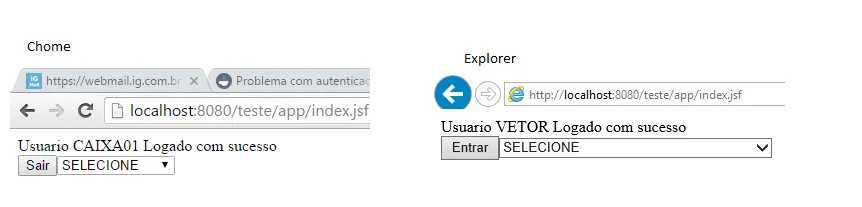

Pessoal seguinte, hj eu tenho alguns clientes, e os dados desses clientes como servidor q o banco de dados esta e o endereco do banco esta tudo dentro de um banco de dados chamado “Gestor”, a partir do endereco desse banco de dados eu entro no banco de dados do cliente, até ai tudo bem, estou utilizando JPA fiz 2 PU para isso e to fazendo a conexao correta, o meu problema é quando eu crio os filter para sessao do usuario . Quando eu entro no mozilla com o usuario X , eu fiz so uma pg de teste para ver se estava ok, voltando quando eu entro com o cliente X E abro a pagina de teste tudo ok , quando eu entro com o cliente Y em outro navegador e atualizo a pagina do cliente X, os dados do cliente Y como ex : Loja, estao para o cliente X, mas o nome do usuario nao muda, estou colocando toda a minha codigicação :
Segue Classe de Conexão :
`package DAO;
import java.util.Properties;

import javax.persistence.EntityManager;

import javax.persistence.EntityManagerFactory;

import javax.persistence.Persistence;
public class Conexao {
private static EntityManagerFactory emf = Persistence.
		createEntityManagerFactory("GestorPU");

public static EntityManager getEntityManager(String PU, String Local) {

            if(PU.equals("0")){
                emf = Persistence.createEntityManagerFactory("GestorPU");
            }else{
                Properties props = new Properties();
                props.setProperty("hibernate.connection.url", "jdbc:firebirdsql:localhost/3050:" + Local);
                emf = Persistence.createEntityManagerFactory(PU, props);
            }


	return emf.createEntityManager();
}
    public static EntityManager getEntity() {
	return emf.createEntityManager();
}
}
`
Segue minha Classe DAO :
`/*
- To change this license header, choose License Headers in Project Properties.
- To change this template file, choose Tools | Templates
- and open the template in the editor.
*/
package DAO;
import Entity.Cadgru;

import Entity.Cadloj;

import Entity.Cadusr;

import Entity.Reljva;

import java.io.UnsupportedEncodingException;

import java.security.MessageDigest;

import java.security.NoSuchAlgorithmException;

import java.util.ArrayList;

import java.util.List;

import javax.ejb.Stateless;

import javax.persistence.EntityManager;

import javax.persistence.EntityTransaction;

import javax.persistence.NoResultException;

import javax.persistence.Query;
/**
*
-
@author Felipee
*/
@Stateless
public class GestorDAO {Cadusr retorno; Cadgru cadgru; EntityManager gestorem; EntityTransaction gestortx; EntityManager mitryusem; EntityTransaction mitryustx; public static Cadusr usu = new Cadusr();
public Reljva chamadaMitryus(String gr,String token) {

gestorem = Conexao.getEntityManager(“0”, null);

gestortx = gestorem.getTransaction();

gestortx.begin();
cadgru = gestorem.find(Cadgru.class, gr);
 gestortx.commit();

 gestorem.close();
 mitryusem = Conexao.getEntityManager("MitryusPU", cadgru.getEndfdb());
 mitryustx = mitryusem.getTransaction();
 mitryustx.begin();
 String jpql = "select a from Reljva a where a.TOKEN = :token";
 Query query = mitryusem.createQuery(jpql, Reljva.class);
 query.setParameter("token", token);
 return (Reljva) query.getSingleResult();
}
public Cadusr buscaPorId(String gr, String usr, String senha) {

gestorem = Conexao.getEntityManager(“0”, null);

gestortx = gestorem.getTransaction();

gestortx.begin();
cadgru = gestorem.find(Cadgru.class, gr);
 gestortx.commit();

 gestorem.close();
 if (cadgru != null) {
     mitryusem = Conexao.getEntityManager("MitryusPU", cadgru.getEndfdb());
     mitryustx = mitryusem.getTransaction();
     mitryustx.begin();
     String jpql = "select a from Cadusr a where a.nomusr = :nomusr and a.pasusr = :pasusr";
     Query query = mitryusem.createQuery(jpql, Cadusr.class);
     query.setParameter("nomusr", usr);
     query.setParameter("pasusr", senha);
     try {
         retorno = (Cadusr) query.getSingleResult();
         mitryustx.commit();

         mitryusem.close();
         if (retorno == null) {
             gestorem = Conexao.getEntityManager("0", cadgru.getEndfdb());
             gestortx = gestorem.getTransaction();
             gestortx.begin();

         }
     } catch (NoResultException nre) {

     }

 } else {
     retorno = null;
 }

 return retorno;
}
public String usuarioLogado() {

String Usuario = usu.getCodusr() + “-” + usu.getNomusr();

return Usuario;

}
private String convertStringToMd5(String valor) {

MessageDigest mDigest;

try {

//Instanciamos o nosso HASH MD5, poderíamos usar outro como

//SHA, por exemplo, mas optamos por MD5.

mDigest = MessageDigest.getInstance(“MD5”);
//Convert a String valor para um array de bytes em MD5
     byte[] valorMD5 = mDigest.digest(valor.getBytes("UTF-8"));

     //Convertemos os bytes para hexadecimal, assim podemos salvar
     //no banco para posterior comparação se senhas
     StringBuffer sb = new StringBuffer();
     for (byte b : valorMD5) {
         sb.append(Integer.toHexString((b & 0xFF) | 0x100).substring(1, 3));

     }

     return sb.toString();

 } catch (NoSuchAlgorithmException e) {
     // TODO Auto-generated catch block
     e.printStackTrace();
     return null;
 } catch (UnsupportedEncodingException e) {
     // TODO Auto-generated catch block
     e.printStackTrace();
     return null;
 }
}
public List lojas() {

EntityManager em = Conexao.getEntity();

EntityTransaction tx = em.getTransaction();

tx.begin();

List lojas = new ArrayList<>();

String jpql = “from Cadloj”;

Query query = em.createQuery(jpql, Cadloj.class);

lojas = query.getResultList();

return lojas;
}
}
`
Segue meu persistence :
`<?xml version="1.0" encoding="UTF-8"?>
org.hibernate.ejb.HibernatePersistence
Entity.Cadgru
true
org.hibernate.ejb.HibernatePersistence
Entity.Cadusr
Entity.Cadloj
Entity.Cadfun
Entity.Tipcli
Entity.Tipven
Entity.Vendas
Entity.Venda_Sintetico
Entity.CodigoPin
Entity.Codloc
Entity.VendaEvolucao
Entity.Reljva
<exclude-unlisted-classes>true</exclude-unlisted-classes>
<properties>
  <property name="hibernate.connection.driver_class" value="org.firebirdsql.jdbc.FBDriver"/>
  <property name="hibernate.connection.username" value="SYSDBA"/>
  <property name="hibernate.connection.password" value="masterkey"/>
  <property name="hibernate.dialect" value="org.hibernate.dialect.FirebirdDialect"/>
</properties>
Segue meu LoginAuth :
`/*
- To change this license header, choose License Headers in Project Properties.
- To change this template file, choose Tools | Templates
- and open the template in the editor.
*/
package filtro;
import Entity.Cadusr;

import java.io.IOException;

import java.io.PrintStream;

import java.io.PrintWriter;

import java.io.StringWriter;

import javax.servlet.Filter;

import javax.servlet.FilterChain;

import javax.servlet.FilterConfig;

import javax.servlet.ServletException;

import javax.servlet.ServletRequest;

import javax.servlet.ServletResponse;

import javax.servlet.annotation.WebFilter;

import javax.servlet.http.HttpServlet;

import javax.servlet.http.HttpServletRequest;

import javax.servlet.http.HttpServletResponse;

import javax.servlet.http.HttpSession;
/**
*
-
@author Felipee

*/

@WebFilter(filterName = “loginAuth”, urlPatterns = {"/seguranca/login.jsf"})

public class LoginAuth implements Filter {
private static final
boolean debug = true;// The filter configuration object we are associated with. If
// this value is null, this filter instance is not currently
// configured.
private FilterConfig filterConfig = null;public LoginAuth() {
}private void doBeforeProcessing(ServletRequest request, ServletResponse response)
throws IOException, ServletException {}
private void doAfterProcessing(ServletRequest request, ServletResponse response)
throws IOException, ServletException {}
public void doFilter(ServletRequest request, ServletResponse response,

FilterChain chain)

throws IOException, ServletException {

HttpServletRequest req = (HttpServletRequest) request;

HttpServletResponse res = (HttpServletResponse) response;

HttpSession session = (HttpSession) req.getSession();

Cadusr user = (Cadusr) session.getAttribute(“usuario”);

if (user == null) {

chain.doFilter(request, response);

} else {

res.sendRedirect(req.getContextPath() + “/app/index.jsf”);
}}
/**
- Return the filter configuration object for this filter.
*/
public FilterConfig getFilterConfig() {
return (this.filterConfig);
}
/**
- Set the filter configuration object for this filter.
-
@param filterConfig The filter configuration object
*/
public void setFilterConfig(FilterConfig filterConfig) {
this.filterConfig = filterConfig;
}
/**
- Destroy method for this filter
*/
public void destroy() {
}
/**
- Init method for this filter
*/
public void init(FilterConfig filterConfig) {
}
/**
- Return a String representation of this object.
*/
@Override
public String toString() {
if (filterConfig == null) {
return (“NovoFilter()”);
}
StringBuffer sb = new StringBuffer(“NovoFilter(”);
sb.append(filterConfig);
sb.append(")");
return (sb.toString());
}
private void sendProcessingError(Throwable t, ServletResponse response) {
String stackTrace = getStackTrace(t);if (stackTrace != null && !stackTrace.equals("")) { try { response.setContentType("text/html"); PrintStream ps = new PrintStream(response.getOutputStream()); PrintWriter pw = new PrintWriter(ps); pw.print("<html>\n<head>\n<title>Error</title>\n</head>\n<body>\n"); //NOI18N // PENDING! Localize this for next official release pw.print("<h1>The resource did not process correctly</h1>\n<pre>\n"); pw.print(stackTrace); pw.print("</pre></body>\n</html>"); //NOI18N pw.close(); ps.close(); response.getOutputStream().close(); } catch (Exception ex) { } } else { try { PrintStream ps = new PrintStream(response.getOutputStream()); t.printStackTrace(ps); ps.close(); response.getOutputStream().close(); } catch (Exception ex) { } }
}
public static String getStackTrace(Throwable t) {

String stackTrace = null;

try {

StringWriter sw = new StringWriter();

PrintWriter pw = new PrintWriter(sw);

t.printStackTrace(pw);

pw.close();

sw.close();

stackTrace = sw.getBuffer().toString();

} catch (Exception ex) {

}

return stackTrace;

}
public void log(String msg) {

filterConfig.getServletContext().log(msg);

}
- Return the filter configuration object for this filter.
}
`
Segue meu Bean :
`/*
- To change this license header, choose License Headers in Project Properties.
- To change this template file, choose Tools | Templates
- and open the template in the editor.
*/
package Controller;
import DAO.GestorDAO;

import Entity.Cadloj;

import Entity.Cadusr;

import java.io.Serializable;

import java.util.List;

import javax.faces.bean.ManagedBean;

import javax.faces.bean.SessionScoped;

import javax.faces.context.FacesContext;

import javax.servlet.http.HttpSession;
/**
*
-
@author Felipee
*/
@ManagedBean
@SessionScoped
public class Bean implements Serializable{private String Usuario; private String Grupo; private String senha; private List lojas; private GestorDAO gestor = new GestorDAO();
public String Vusuario() {
Cadusr user = getGestor().buscaPorId(getGrupo(), getUsuario(), getSenha());if ( user != null) { HttpSession sess = (HttpSession) FacesContext.getCurrentInstance().getExternalContext().getSession(false); sess.setAttribute("usuario", user); return "/app/index.xhtml?faces-redirect=true"; }else{ return "/seguranca/login.xhtml?faces-redirect=true"; }
}

public String sair(){

FacesContext.getCurrentInstance().getExternalContext().invalidateSession();

return “/seguranca/login.xhtml?faces-redirect=true”;

}
/**
-
@return the Usuario
*/
public String getUsuario() {
return Usuario;
}
/**
-
@param Usuario the Usuario to set
*/
public void setUsuario(String Usuario) {
this.Usuario = Usuario;
}
/**
-
@return the Grupo
*/
public String getGrupo() {
return Grupo;
}
/**
-
@param Grupo the Grupo to set
*/
public void setGrupo(String Grupo) {
this.Grupo = Grupo;
}
/**
-
@return the senha
*/
public String getSenha() {
return senha;
}
/**
-
@param senha the senha to set
*/
public void setSenha(String senha) {
this.senha = senha;
}
/**
-
@return the lojas
*/
public List getLojas() {lojas = new GestorDAO().lojas(); return lojas; }
/**
-
@param lojas the lojas to set
*/
public void setLojas(List lojas) {
this.lojas = lojas;
}
/**
-
@return the gestor
*/
public GestorDAO getGestor() {
return gestor;
}
/**
-
@param gestor the gestor to set
*/
public void setGestor(GestorDAO gestor) {
this.gestor = gestor;
}
-
@return the Usuario
}
`